
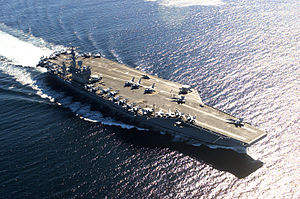
The Nimitz-class supercarriers are a class of ten nuclear-powered aircraft carriers in service with the United States Navy. The lead ship of the class is named for World War II United States Pacific Fleet commander Fleet Admiral Chester W. Nimitz, the U.S. Navy's last fleet admiral. With an overall length of 1,092Â ft (333Â m) and full-load displacement of over 100,000 long tons,
All ten carriers were constructed by Newport News Shipbuilding Company in Virginia. USSÂ Nimitz, the lead ship of the class, was commissioned on 3 May 1975, and USSÂ George H.W. Bush, the tenth and last of the class, was commissioned on 10 January 2009. Since the 1970s, Nimitz-class carriers have participated in many conflicts and operations across the world, including Operation Eagle Claw in Iran, the Gulf War, and more recently in Iraq and Afghanistan.
The angled flight decks of the carriers use a CATOBAR arrangement to operate aircraft, with steam catapults and arrestor wires for launch and recovery. As well as speeding up flight deck operations, this allows for a much wider variety of aircraft than with the STOVL arrangement used on smaller carriers. An embarked carrier air wing consisting of up to around 90 aircraft is normally deployed on board. After the retirement of the F-14 Tomcat, the air wings' strike fighters are primarily F/A-18E and F/A-18F Super Hornets and F/A-18A+ and F/A-18C Hornets. In addition to their aircraft, the vessels carry short-range defensive weaponry for anti-aircraft warfare and missile defense.